Hard alloy is an alloy material made by powder metallurgy process from hard compounds of refractory metals and bonding metals. Its performance is closely related to the mixing process, so the requirements for mixers in this industry are very high. Hard alloy has a series of excellent properties such as high hardness, good wear resistance, good strength and toughness, heat resistance, corrosion resistance, etc. Especially its high hardness and wear resistance remain basically unchanged even at 500℃, and still have high hardness at 1000℃.
Only efficient 3D mixers can meet the high demands of the hard alloy industry. Hard alloy is widely used as a tool material, such as turning tools, milling tools, planing tools, drills, boring tools, etc., for cutting cast iron, non-ferrous metals, plastics, fibers, graphite, glass, stone and ordinary steel, and can also be used to cut difficult to machine materials such as heat resistant steel, stainless steel, high manganese steel, tool steel, etc.
The hardness and wear resistance of hard alloy materials are roughly divided into three types: ① tungsten cobalt type hard alloy; ② tungsten titanium cobalt type hard alloy; ③ tungsten titanium tantalum (niobium) type hard alloy. The appropriate grade of hard alloy tools should be selected according to different usage environments.
The raw materials of hard alloy tools are divided into primary materials and recycled materials. Primary materials are alloy materials mainly composed of tungsten powder extracted from ores, and recycled materials are alloy materials processed from recycled hard alloy waste tools.
Today, I will focus on the specific processing procedures for recycled used alloy cutting tools: Recycling old cutting tools - Crushing - Mixing - Wet ball milling - Spray granulation - Different grades of alloy powders - Pressing - Sintering - Finished product.
Since the recycled cutting tools are collected from different users, the content of the same alloy element in each manufacturer's same grade alloy may have a certain error. After the same grade produced cutting tools are processed into powder through the production process, the processed powder is mixed evenly according to the production volume, samples are taken to test the alloy element composition of this batch of powder, and the required alloy elements are added according to the process ratio. Therefore, the uniformity of the powder in the mixing process is of crucial importance.
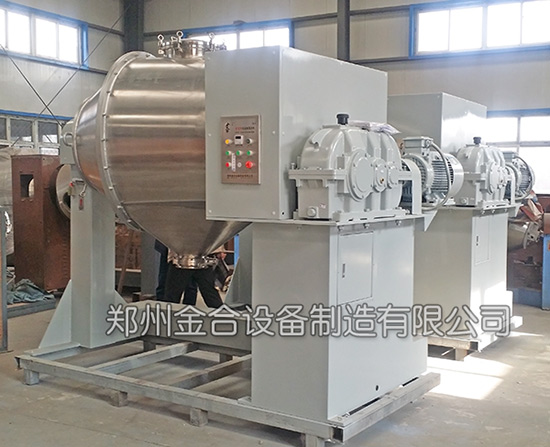
Most enterprises in the hard alloy industry use gravity diffusion type mixers. The models are mainly traditional double cones or V shaped. The principle of gravity diffusion mixing is to continuously raise the center of gravity of the powder to use gravity to force the powder to repeatedly undergo convection and diffusion. The advantage of this type of mixer is that there are no dead corners, and the powder moves and flows inside the bucket relatively quickly. The powder is basically uniform in up, down, left and right directions, achieving the uniformity required by the process. The disadvantage is that the microscopic particles of the powder change slowly, and the added trace elements cannot be completely diffused into the main powder.
The double motion 3D mixer is a combination of gravity diffusion mixing and forced shearing and stirring mixing: The drum rotates to perform gravity diffusion mixing on the materials while the internal screw blades move in the same direction and at different speeds to perform forced shearing and stirring mixing on the materials. The hard alloy powder mixed by the double motion mixer, in addition to achieving the uniformity required by the mixing process on a macroscopic level, can also achieve microscopic uniformity between particles. Only when the powder mixture of the alloy material is uniformly mixed at the microscopic level can the alloy performance reach the best performance. Therefore, the double motion 3DA mixer is the best choice for the mixing process in the hard alloy industry.

 ENGLISH
 PREV