Thermal insulation materials are primarily used for insulating industrial equipment and pipelines. Among various insulation technologies and materials, aerogel was first applied by NASA in the insulation lining of spacesuits developed for space exploration.
Aerogel insulation materials feature low thermal conductivity, low density, high flexibility, and excellent fire and water resistance. Their thermal conductivity at room temperature can be as low as 0.018 W/(m·K), and they offer excellent water resistance. Their thermal insulation performance is approximately 3–8 times better than that of traditional materials.
These materials are also lightweight, with typical densities ranging from 10 to 96 kg/m³. Depending on density, they can be classified into the following types:
Below 20 kg/m³: Flexible insulation blankets
24–48 kg/m³: Semi-rigid insulation boards
48–96 kg/m³: Rigid insulation boards
Materials with a density of 48 kg/m³ can also be used for ceiling applications. Their softening point is approximately 500°C, and they can provide thermal insulation at temperatures of up to 300°C. They are widely used in the United States, with a K-value of 0.9.
Due to the unique properties of thermal insulation materials, specific requirements must be met by the mixing equipment used in their production. In particular, as the requirements for new building materials continue to increase, the construction industry increasingly requires high-efficiency dry powder mixers to meet the production demands of the thermal insulation materials industry.
Dry powder mixers used in the thermal insulation materials industry must meet the evolving requirements of the construction sector. These requirements are closely related to the applications and performance characteristics of the materials.
Calcium silicate insulation products were successfully developed in China in the 1970s. They feature high compressive strength, low thermal conductivity, convenient installation, and reusability. These materials are widely used in power generation and electrical systems.
Their main characteristics include an acidity coefficient above 2.0 and excellent high temperature resistance. They are commonly used for industrial chemical pipelines operating at temperatures exceeding 1,000°C. The material has a melting temperature of approximately 2,000°C.
Currently, the main raw materials used in new thermal insulation products include expanded polystyrene (EPS) and polyurethane (PU) foam. However, their applications in the construction industry still face certain challenges.
These materials are mainly used in steel wire mesh sandwich panels and color coated steel sandwich panels. Although their applications are subject to certain limitations, their market development has been relatively rapid.
As fire safety requirements for construction materials become increasingly stringent, new challenges have emerged regarding the application of these materials. The issue is not simply how to mix the materials, but also how to select the appropriate dry powder mixing equipment.
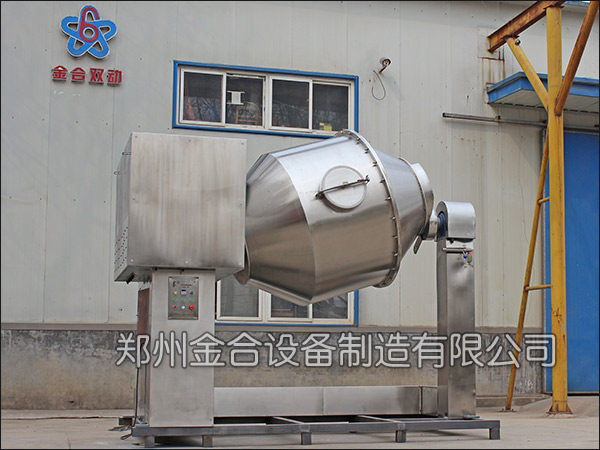
Due to differences in bulk density, thermal insulation formulations often contain both lightweight and heavy powders. Achieving a uniform mixture of these materials can be particularly challenging.
The Jinhe Dual Motion Dry Powder Mixer addresses this challenge through a unique mixing mechanism. Inside the rotating mixing vessel, a full size rotating blades is installed. The agitator rotates in the same direction as the vessel, at twice the rotational speed of the vessel.
This synchronized dual-motion design allows the vessel and ribbon agitator to work together to capture lightweight powders floating near the upper surface and bring them down into the main body of heavier powders. As a result, lightweight and heavy powders can be mixed more uniformly.
Some manufacturers of conventional mixing equipment have also recognized this mixing principle and attempted to solve the problem by modifying their existing equipment, such as installing a rotating ribbon agitator inside a traditional double cone mixer.
However, such modifications cannot fundamentally resolve the difficulty of mixing lightweight and heavy powders.
This is because the structural design of a double-cone mixer limits the size of the ribbon agitator that can be installed. When lightweight powders float near the upper part of the mixing vessel, the relatively small agitator cannot effectively capture and incorporate these powders into the mixing process.
The Dual Motion Dry Powder Mixer can achieve a filling rate of up to 80%. This high filling rate reduces the space available for lightweight powders to float and increases the internal packing pressure of the powder mixture.
The rotating vessel ensures that materials are continuously moved throughout the mixing chamber, minimizing dead zones. Meanwhile, the ribbon agitator performs shearing, stirring, intermixing, and material conveying, which are the primary mechanisms responsible for achieving a uniform mixture.
In contrast, traditional double cone, three dimensional, and V-type mixers mainly rely on gravity driven diffusion mixing.
These conventional mixers must retain sufficient internal space for materials to tumble and redistribute during operation. Consequently, their optimal filling rate is generally no higher than 50%.
The relatively large floating space inside these mixers makes it difficult to achieve uniform mixing of lightweight and heavy powders.
This is why the Dual Motion Dry Powder Mixer offers a significant advantage over conventional mixing equipment in addressing the challenge of uniformly mixing powders with substantially different bulk densities.

 ENGLISH
 PREV